

Everyone Wants to Call the Shots
Who should own AI orchestration in the contact center is a question with several potential answers: your customer relationship management (CRM) provider, your contact center platform, an AI specialist, or a hyperscaler. Ask CX leaders today, and you get one answer. Ask what they’re planning for 2028, and you get a very different one.
Little wonder that we’ll see a shift over the next year. Orchestration is moving from niche to mainstream fast. In Metrigy’s Contact Center & Beyond: Elevating CX 2026-27 global study of 626 companies, AI orchestration adoption climbs from 29.2% of companies in 2026 to 44.7% in 2028. The companies getting the best results from AI, what we call the Research Success Group, are moving fastest. We define orchestration as the intelligent coordination of AI, humans, data, applications, workflows, and channels to determine and execute the next-best action throughout a customer interaction or journey. Whichever owns orchestration decides what happens in every interaction and not surprisingly, every vendor category wants that job.
CRM Leads Today, Thanks to Relationships
CRM providers are the top pick to own orchestration (32.3%) today, with AI specialists close behind. CRM already sits at the center of most CX stacks and holds the customer record, so letting it decide the next-best action feels like a natural extension. It’s also the platform most companies call home today.
Companies pick an orchestration owner first on the quality of the existing relationship, ahead of intelligent routing and reasoning, the capabilities that actually make orchestration work. Among companies choosing CRM, the relationship counts even more. Many buyers are picking the vendor they’re comfortable with and hoping the capabilities follow.
Incumbency is fine as a tiebreaker between providers, but I’d say it’s a weak reason to hand over control of every customer interaction.
AI Specialists Tomorrow
Yet many of the same buyers who favor CRM for orchestration today plan to move away from it as their primary platform. By the end of 2028, AI specialists (AI agent and analytics tool providers, which some may also consider to be CRM or contact center-as-a-service (CCaaS) providers that have native AI products,) become the primary customer interaction platform for 48.1% of companies, up from 27.7% today, while CRM drops to 21.2%.
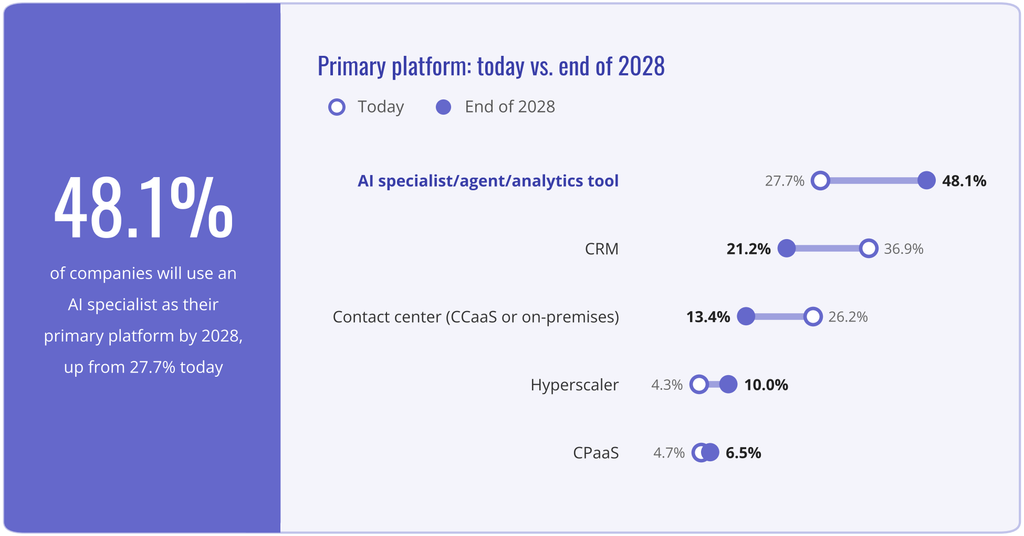
Figure 1: AI specialists become the primary customer interaction platform for 48.1% of companies by 2028; source: Metrigy’s Contact Center & Beyond: Elevating CX 2026-27 (626 companies)
Why switch at all? Technology innovation and the need for better AI reasoning top the list, followed by intelligent routing requirements. More than half of companies picking an AI specialist to own orchestration cite intelligent routing. The Success Group leans this way, too, naming AI specialists as best equipped to own orchestration significantly more often than the Non-Success Group and more often counting one as its primary platform today.
CRM providers should read that as a warning. To keep the customer interaction, they’ll need to compete on reasoning and routing. Undoubtedly, this was one reason behind Salesforce’s move into CCaaS and its recent announcement to acquire Cresta, which brings a specialty in conversation intelligence.
CCaaS providers own much of the information needed to route interactions intelligently. These drivers are good news for those CCaaS providers that have their own native AI platforms (NiCE Cognigy, UJET + Spiral, and, as of recently, Dialpad + Ada, for example), hence the spate of CCaaS acquisitions and mergers we’ve seen in the last year.
CCaaS and Hyperscalers: Lagging, but Not Out
Perception of providers and what they do matters. Fewer than one in 10 companies see CCaaS providers as best equipped to own orchestration, and hyperscalers draw almost no votes. Both trail partners/resellers/integrators and global network providers. As a primary platform, the contact center’s share roughly halves by 2028.
Don’t write off CCaaS, though. The Success Group picks CCaaS providers to own orchestration significantly more often than the Non-Success Group. Companies choosing CCaaS cite intelligent routing, business workflow role, and channels in use—the plumbing orchestration can’t run without. Some of this movement depends on marketing—really! Take NiCE Cognigy as an example. CX leaders who view the company only as a CCaaS provider won’t be as apt to consider them as their primary orchestration vendor as those who view them as an AI specialist. In reality, NiCE Cognigy is both, and both are important. But those considered “AI specialists” are driving the decisions of who will own orchestration.
Hyperscalers’ share as a primary platform more than doubles by 2028. Microsoft and Google top the list of providers best equipped to deliver native CX products, just ahead of Salesforce. Google, Microsoft, and AWS are also among the most used AI platforms for customer service, broadly speaking. Buyers clearly trust these brands, but few see them as orchestrators today.
Build It Into the Core, but Who Sits at the Table?
How companies orchestrate matters as much as which platform does it. Two-thirds say building orchestration into the core of a platform beats orchestrating apps and systems at the edge, and the Success Group is even more convinced. Meanwhile, the open-standards route is early: Fewer than one in five companies use Model Context Protocol (MCP) to connect CX applications today, though more than a third plan to in 2027.
Inside the company, IT owns CX orchestration at nearly half of organizations, while the contact center owns it at fewer than one in five. This is fine, providing the contact center leaders are providing guidance on what they need from orchestration. The function itself is a mix of business requirements and technical design, so coordination between the operational and technical groups are vital.
The obstacles are familiar ones: security and compliance, accuracy of outcomes, and trust of the models. In fact, security/governance/compliance is also the single biggest concern about deploying more AI in the contact center.
What CX Leaders Should Do
Orchestration ownership is up for grabs, and buyers’ own plans show it. Metrigy recommends the following:
- Pick an owner on capability. Score candidates on reasoning and intelligent routing, two of the top reasons companies give for changing platforms.
- Plan for a platform change. With more than four in 10 companies changing provider types within two years, negotiate data portability now so your orchestration logic isn’t locked into a platform you’re about to leave.
- Keep the contact center in the room. IT is the most common owner of orchestration. Pair it with the contact center leaders who know the routing rules, the customers, and the business value.
- Make security the first gate. Security is the top inhibitor to orchestration success, so build compliance and model testing before you scale.
Whichever platform provider wins the orchestration fight will own the customer interaction. Make that decision on purpose, with your 2028 platform plans in mind.
As we look toward 2027, the foundational markets Metrigy covers are progressing as forecasted with minimal change based on 1H26 actual numbers. Let’s break it down and how things could shift and change through 2027.
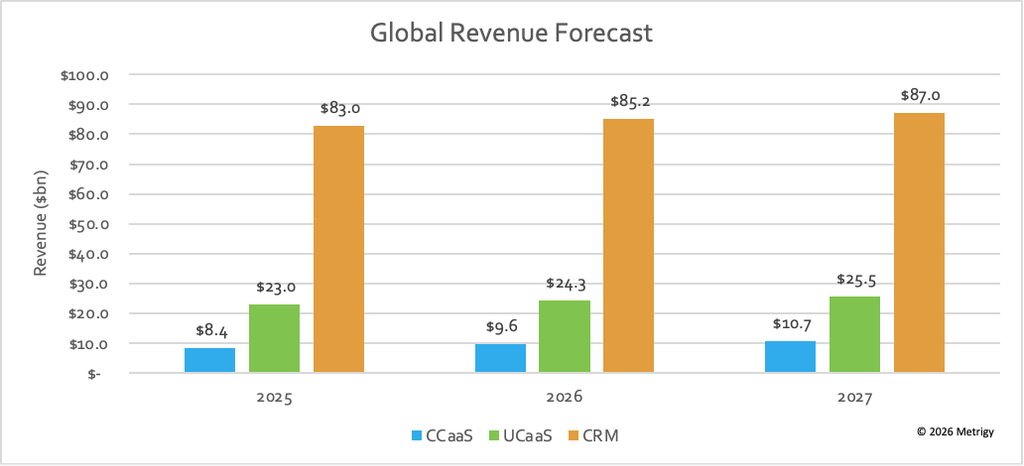
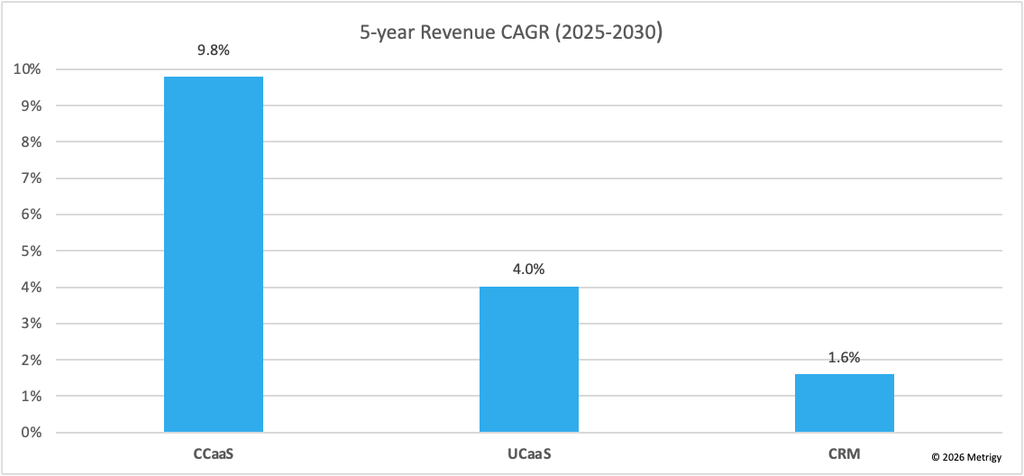
For CX, customer relationship management (CRM) is the largest market segment, on track to post $85.2 billion in 2026 revenue. On the flip side, contact center as a service (CCaaS) is the fastest growing market segment, albeit from the smallest base ($9.6 billion forecast for 2026).
While the CRM market is large, most companies that need a CRM system already have one so for providers to grow they need to be winning new business from competitors. Salesforce commands more than a quarter of the market. And the market is on track to continue growing at low single digits off a large base. We expect the continued expansion and evolution of AI, as well as the shift of CRM vendors to a headless model, relying on other AI apps to interface with data, to blur the lines between CRM and other customer experience platforms like CCaaS.
Of all the segments we track, CCaaS currently has the largest adoption upside since human contact center agents still operate predominantly from on-premises systems and dedicated cloud platforms. According to our research, with more than 50% of human agents still to migrate over to CCaaS, plus AI capabilities that add to premium pricing, there is a long on-ramp to growth. The CCaaS market is the one area where the growth attached to AI is hard to fully forecast beyond three years because the evolution of AI is outpacing what we can fathom and what businesses can keep up with beyond 12-24 months.
The market share leaders in CCaaS continue to be NiCE, Genesys, and Five9. However, this market has a broad set of competitors and new entrants, such as Microsoft, Salesforce, and Zoom, are making strides every year.
For workplace collaboration, unified communications-as-a-service (UCaaS) growth is steady as businesses continue to migrate off on-premises PBX and dedicated cloud platforms, even though many are de-emphasizing traditional phone service for employee communications, focusing instead on video conferencing and chat services. AI has long been used to augment UC through transcription and translation, and continue to expand these capabilities with the integration of context beyond meetings into note takers. We do not anticipate AI upending the UCaaS market but rather continue to enhance capabilities.
UCaaS is forecast to grow to $25.5 billion in 2027. Microsoft is the global market share revenue leader followed by RingCentral and Zoom. The leadership should hold steady at the top with smaller companies prone to consolidation or acquisition.
CRM: A platform for managing a company’s relationships and interactions with customers and prospects for contact and sales management. The tools often integrate with project management, marketing automation, contact center, and many other applications and platforms.
What We Count
In this service, we report vendor and provider revenue in US$ recognized during the calendar year and quarters.
Regions
- Worldwide: all areas of the world
- North America: U.S. and Canada
- EMEA: Europe, the Middle East, and Africa
- Asia-Pacific: Asia and the Pacific, including Japan and Australia
- CALA: Caribbean and Latin America, including Mexico
Ratings from 1,400+ business technology leaders globally define MetriStar program
May 6, 2026 – Research and advisory firm Metrigy announced winners of its 2026 Customer Experience MetriStar program in nine key technology areas that drive successful customer interactions.
Metrigy determines these results based solely on insights from 1,437 CX, IT, and business leaders with decision-making, operational, and/or procurement responsibilities for specific technologies in our Customer Experience MetriCast 2026 global research study.
“Business leaders are demanding more multi-dimensional products, and technology providers are responding with capabilities that resonate,” says Metrigy CEO Robin Gareiss. “Through feedback from these IT and CX leaders, we know that they are generally pleased with the state of the technology available, but they also want to see rapid technology innovation, more integrations, and more automation, among others.”
Unlike other award programs, the MetriStars give enterprise decision-makers unique insight into what really matters based on real-world usage and experience with the technology vendors. Metrigy asks enterprises to rate their providers on a variety of metrics, such as AI capabilities, security, integration, and value, making up the Customer Sentiment Score. In addition, Metrigy asks the research participants how the use of their products improves or increases customer satisfaction, revenue, employee efficiency, and operational costs—collectively comprising the Business Success Score.
Each report features three recognitions, as follows:
- MetriStar Top Provider – Recognizes technology providers whose customers achieved high business success and that received at or above-average customer sentiment ratings
- Top Business Success – Highlights providers whose percentage of customers achieving business success is above average
- Top Customer Sentiment – Highlights providers whose customer sentiment scores are at or above average
CX, IT, and business leaders rated their vendors’ performance and provided associated business success across the CX technologies, resulting in 43 MetriStar Top Provider Awards, up from 32 providers last year. This helps enterprises develop short-lists for their technology evaluations.
This year’s MetriStar Top Provider winners, listed alphabetically, include:
- Agent Assist – Cresta, Forethought, IBM, NiCE, Observe.AI
- AI Agents – Ada, Aisera, AWS, Cresta
- CCaaS Platforms – 8×8, Cisco, Genesys, NiCE, RingCentral, Twilio
- CPaaS Platforms – 8×8, Bandwidth, Gupshup, RouteMobile, Twilio
- CRM Platforms – Freshworks, Hubspot, Oracle, Servicenow, Zoho
- Interaction Analytics Platforms – AWS, Cresta, Five9, Google, NiCE
- Knowledge Management – NiCE, Salesforce, ServiceNow, Zoho
- Voice of the Customer – Alchemer, Confirmit, Cresta, Medalia, NiCE, Qualtrics
- Workforce Engagement Management Suites – Aspect, RingCentral, Zoho
Another 31 vendors won awards for either customer sentiment or business success. For more details and a full review of each category and its winners, please see our MetriSight podcast announcing the results. Metrigy clients have access to the reports, and they are available for purchase on our website at www.metrigy.com.
Which CX providers are delivering the best business value for their customers and receive the highest customer sentiment ratings across nine product categories? We provide the rundown in this episode. Tune in to discover which vendors get their customers’ nod for agent assist, AI agents, CCaaS, conversation analytics, CPaaS, CRM, self-service knowledge management, VoC, and WEM.
Metrigy has published its CRM 2025 & 4Q25 market shares and updated forecasts; Salesforce maintains lead
April 16, 2026 – Metrigy has published its Customer Experience MetriCast Market Share, 2025 and 4Q2025 market shares and updated forecasts. In addition to CRM, the categories include contact center as a service (CCaaS), communications platform as a service (CPaaS), and contact center platforms. Highlights include:
- CRM is the largest product category within the areas we forecast, topping out at $83.0 billion in 2025, up 3.0%.
- Salesforce leads the CRM market with 25.8% global revenue share in 2025. Other leading providers include Microsoft, Adobe, and Oracle.
- While Salesforce has long been the undisputed leader in the CRM market, there is still room for smaller vendors to grow and thrive. In 2025, Pegasystems and HubSpot posted the largest revenue gains at 25.3% and 19.2%, respectively.
“The CRM market is in transition, as businesses evaluate where and how customer data is stored and managed, but it’s not fully going away. Metrigy forecasts a 1.6% CAGR from 2025-2026,” says Diane Myers, Metrigy senior research director and principal analyst.
The MetriCast market shares and updated forecasts is a core part of Metrigy’s MetriCast Service, which also includes detailed end-user adoption studies, MetriRank vendor ratings across select categories, and the annual MetriStar Awards for vendors earning top customer sentiment ratings and whose customers achieve top business success. For more information and to purchase this report, visit https://www.metrigy.com/product/crm-quarterly-market-share-forecast-report-2025-4q25/
Companies plan on improving agent desktop interfaces to foster customer experience.
CRM has long been a staple in sales interactions, marketing campaigns, and customer records. But now it is growing in prominence in the contact center as the agents’ primary desktop interface. Agents are distracted when they must toggle between multiple applications that may or may not be integrated. The transformation projects can take many forms, but some CX leaders see one of the top strategies for improving and streamlining the agent desktop is to designate CRM as the interface for contact center employees.
More than 44% of companies cited plans to improve the agent desktop interface as one of their CX transformation projects, according to Metrigy’s Customer Experience Optimization (CXO) 2025-26 global study of 656 companies.
In 2025, 47.9% of companies used the contact center platform as the primary interface for agents, and 43.2% used the CRM platform’s interface. By the end of 2027, those figures drastically shift to 32.4% and 53.4%, respectively, according to the same CXO study.
What’s driving this change in the contact center? In general, companies prefer a CRM desktop for contact center agents in the following circumstances:
-
Customer context matters more than call handling
-
Revenue and customer retention drive the most value
-
AI, analytics, and workflow automation must continue beyond the interaction
Other triggers also resulted in CRM’s growing role, including improved integrations; the use of digital channels from CRM platforms; the need for context for personalized, proactive outreach; and the role of sales in customer service interactions.
Improved Integrations Between System of Record and Interaction Platforms
Continue reading at nojitter.com.
By integrating contact center software with back-office apps, companies can improve employee productivity, customer satisfaction and ultimately their bottom line.
By now, many enterprise C-suite executives have abandoned the notion that contact centers are cost centers. Instead, the C-suite has embraced the contact center as a value center that drives revenue growth and operational efficiency.
However, for too many organizations, the contact center remains a silo disconnected from customer relationship management (CRM), enterprise resource planning (ERP), service management, unified communications (UC) or other business-critical enterprise applications. This, clearly, is a mistake.
Seamless integration between the contact center and enterprise applications is a key characteristic of success for customer experience operations. Metrigy discovered this correlation in its global “Customer Experience Optimization (CXO): 2025-26” research study of 656 companies.
In this study, the majority of the most successful companies — based on achieving double-digit revenue growth, efficiency boosts and other improvements — have bridged the gap between the contact center and back-end enterprise systems. Unequivocally, this shows that seamless integration isn’t merely a nice-to-have, but it’s a foundational requirement for success.
Executives need access to contact center data
Continue reading at techtarget.com.
Delivers market insights for nine CX technology areas in 2025
September 5, 2025 – Research and advisory firm Metrigy released its Customer Experience MetriCast 2025 market research study of nine key technology areas driving successful customer interactions.
In the Customer Experience MetriCast 2025 study, Metrigy analyzes buy-side market data provided by 1,397 IT leaders from 11 countries across 34 industries with operational and/or procurement responsibilities. Metrigy looks at technologies in use, providers, spending, ratings of the providers, and relative success using the products. Metrigy also examines the percentage of companies that are changing or planning/evaluating a change in providers, what’s driving them to leave, and which new providers they are considering in the following categories:
- Agent assist
- AI agents
- Communication platform as a service (CPaaS)
- Contact center as a service (CCaaS)
- Customer relationship management (CRM)
- Knowledge management
- On-premises & dedicated cloud contact center platforms
- Voice of the customer (VoC)
- Workforce engagement management (WEM)
Among the study’s findings is that 38% of businesses are now using cloud-delivered contact center service, or CCaaS, in some capacity. “Beyond contact center platform and AI spending, the majority of respondents indicated they were keeping CX spending flat in 2025 with economic uncertainty surrounding tariffs and geopolitical concerns. The growth in CCaaS spending is predominantly from additional seats being added along with increases in staffing,” says Diane Myers, Metrigy senior research director. “Chatbots continue to grow in usage with more voicebots coming online.”
The MetriCast study is part of Metrigy’s MetriCast Service, which also includes market forecast and shares across select customer experience and workplace collaboration technology categories, with quarterly updates; MetriRank vendor ratings across select categories; and the annual MetriStar Awards for vendors earning top customer sentiment ratings and whose customers achieve top business success. For more information, visit www.metrigy.com.
Contact center employees have long had a siloed existence, typically separated from their business peers physically as well as virtually. Fortunately, many companies are starting to knock down the barriers, and positive business results are following.
We see evidence in our data on platform integration. For example, integrations not being extensive enough is the No. 3 factor driving companies to explore switching from one vendor to another, as we found in our Customer Experience MetriCast 2024 research with 1,566 organizations globally. This was not the case in previous years’ MetriCast studies.
Similarly, we know from our global Customer Experience Optimization (CXO): 2024-25 research study that most of the 544 participating companies see value in platform integration—and the highest value, at that. Asked to rate value of platform integration on a one-to-seven scale, with one being least valuable and seven most valuable, nearly 87% selected five (18.0%), six (33.7%), or seven (35.2%). Additionally, this study’s success group, based on measured business improvements, is twice as likely to give platform integration the top value rating than the non-success group.
In the CX realm, most companies have already integrated their contact center platforms with a customer relationship management (CRM) platform (70.7%) and, to a lesser degree, a service management platform (50.9%), as we found in the CXO study. More than 40% of companies also already have integrated their contact center and communications platform-as-a-service and AI development platforms. Lower down the list, but directly relevant to being able to take contact center agents out of their silo, is integration with the unified communications-as-a-service (UCaaS) platform.
While 30.1% of companies have already integrated contact center and UCaaS platforms, 43.3% say they are planning to do so. This is the biggest growth area for platform integration.
Without barriers between the customer-facing contact center platform and the employee-facing UC platform, companies stand to benefit in a variety of ways. Some are operational, others impact customer experience. In the CXO study, the top value of contact center-UC integration comes in giving agents (and supervisors) a way to provide feedback for sales and marketing programs based on their customer engagements, for nearly 57% of companies. Similarly, nearly half see value in enabling the sharing of customer feedback with product development teams.
Other value propositions, both for the workforce and operationally, are:
- Providing the opportunity for conversations between frontline and back-office people over the same app – 52.0%
- Cost savings/bundled pricing – 50.4%
- Bringing collaboration capabilities into the contact center – 45.5%
- Allowing agents to bring business experts into customer interactions – 44.7%
- Consolidating analytics across contact center and UC – 42.3%
- Allowing agents to use video or screen-sharing during customer calls – 39.0%
With these capabilities comes business improvement. When asked about the results of integrating contact center and UC for their businesses, 61.0% of companies report higher revenue and better employee productivity. Slightly fewer, 59.8%, have seen CSAT improvement, while 51.2% have seen costs go down.
Worth noting that integrating contact center and UC does not necessarily require using the same provider for both—though many companies do. In the study, three-quarters of companies say they’re using the same provider. And in making that vendor decision, the contact center platform carries more weight than the UC platform for most companies.
For those companies looking to break agents out of their siloed existence, integrated the contact center and UC platforms is highly advisable. Business benefits are sure to follow.


