

Achieving success with employee experience initiatives requires the right mix of technologies and strategies for understanding employee behavior and optimizing engagement. In this webinar, discover data-based insights on how the most successful companies approach employee experience, and what technologies they have in place, from employee experience platforms, intranets, voice-of-the-employee software, and more.
How to Achieve Success When Optimizing Employee Experience
Presented by: Beth Schultz, VP of Research Principal Analyst, Metrigy
Date: May 21, 2024
Time: 11:00 am ET

AI might get all the attention, but IT leaders are also concerned about some other key security vulnerabilities within their unified communications platforms.
Companies are facing a variety of unified communications threats — from AI, toll fraud and improper use of messaging channels — all of which were highlighted at a UC security panel at this year’s Enterprise Connect in Orlando, Fla.
The UC security challenges session, which I moderated, featured a diverse group of vendors. Mark Collier, CTO of SecureLogix, Ram Ramanathan, senior director of product management at Ribbon Communications, and Bryan Mack, master principal consultant at Oracle, represented vendors who have historically been focused on protecting their customers against threats of attack via voice channels. The panel also included Anthony Cresci, senior vice president of go-to-market and partnerships at Theta Lake, which helps companies meet compliance obligations, as well as Smita Hashim, chief product officer of Zoom.
Metrigy has tracked trends in the communications and customer engagement security space for the last several years. We’ve noted that even as security concerns grow — one in five of our research participants report having experienced a security incident — proactive strategies are lacking. Just 35% of organizations report having a proactive, company-wide strategy in place to protect against communications, collaboration and contact center threats.
AI tops security concerns
Continue reading at techtarget.com.
Organizations can use collaboration behavior data to track meeting attentiveness, establish better meeting habits and personalize channel feeds for employees.
Organizations need to realize the value and potential of collaboration data goes beyond assessing and optimizing application performance. By analyzing collaboration data, organizations can gather insights to drive improvements in collaborative work, productivity and wellness — and boost the overall employee experience.
Companies at the forefront of the employee experience consider collaboration behavior data — from applications such as team chat and video meetings — to be vital to understand their employees. More than half of the 499 companies Metrigy examined in a global study on employee experience are using collaboration behavior data as part of their employee experience initiatives. With this data, companies can see how often employees are digitally interacting with each other throughout the day, in what ways they’re interacting and with whom.
Companies can share each employee’s collaboration behavior data on an individual basis, roll the data up for viewing in aggregate by team leaders and other managers, or both. Many companies are finding collaboration behavior data a great complement to engagement data showing how much an employee participates and engages digitally with the company and peers via enterprise social networks or employee portals, as well as to employee sentiment data gathered via surveys and polls.
Unified communications (UC) industry insiders discussed the hidden value in collaboration data during a session at the Enterprise Connect 2024 conference in Orlando, Fla. The industry experts shared three top tips on using collaboration data to its fullest potential.
1. Enhance team engagement and productivity.
Continue reading at techtarget.com.
Companies using Microsoft Teams for meetings and messaging are at an inflection point. They want to add calling and contact center capabilities to Teams, but must do so in a manner that optimizes user experience, minimizes costs, and maximizes availability and reliability. In addition, they must ensure access to new and emerging capabilities to improve customer experience. The ideal path forward is one that leverages a unified calling and contact center solution, natively integrated into Microsoft Teams, with access to composable capabilities for customer engagement. In this Metrigy issue paper, we share our latest data on Teams adoption trends, options for integrating voice and contact center capabilities into Teams, and the benefits of leveraging a unified calling and contact center solution to optimize employee and customer engagement.
Continue reading at vonage.com.
Learn about NG911 and its benefits at this year’s Enterprise Connect panel.
Every fall, for the last several years, as Enterprise Connect planning for the following year commences, the planning team reaches out to ask me, “Are there still 911 topics to discuss next year?” And for each year, my answer is always a resounding “YES!” This year is especially relevant – we are marking the transition in our annual 911 panel from the term E911 for the newer, and more encompassing, NG911. As panelist and colleague Martha Buyer wrote a few weeks ago in her session preview, panelists are coming to the discussion with a number of topics that are top of mind as the evolution from E911 to NG911 commences.
NG911 offers potential to improve public safety by allowing phones and calling apps to use available resources such as network devices, location management servers, and GPS, to determine their location in real-time, rather than relying on a database that may not be up to date, especially in open offices or for hybrid employees. It offers potential for 911 callers to share additional information with first responders ranging from sensor data, to floorplans, to cameras.
As Mark Fletcher noted in Martha’s post, NG911 is here now. However, many — dare I say most — companies are not ready. In fact, many are still not even compliant with the existing regulations that govern 911 dialing, on-site call notification, and dispatchable location as required by Kari’s Law and RAY BAUM’s Act. Metrigy’s 2023 study of 440 organizations found that just 62.7% of participants said their organization was fully compliant with both Kari’s Law and RAY BAUM’s Act. Almost 11% said that they didn’t believe their organization needed to be compliant. More than 15% didn’t know the status of their compliance. These data points are consistent with what we’ve seen in the past as many in telecom roles still don’t fully understand existing regulations or what it even means to be compliant. Obviously, this will be a topic of discussion at our panel.
Compliance, as well as support for NG911, may also create confusion as companies increasingly adopt UCaaS for all or part of their communications environment. There may be a belief that the UCaaS provider will own responsibility both for initial setup as well as ongoing management of user location information, but capabilities vary greatly among providers.
Continue reading at nojitter.com.
While transitioning to cloud calling and maintain older, legacy PBXs and a UCaaS environment, businesses have a few management options to consider.
While businesses quickly adopted cloud-based conferencing and collaboration services during the pandemic, the same cannot be said about cloud-based calling. The reality is while cloud calling has been in the market for over 15 years, the majority of businesses are still on dedicated PBX solutions. Less than 40% of businesses worldwide have migrated to UC as a Service (UCaaS) and businesses are not moving fast to off on-prem PBXs. According to Metrigy’s MetriCast Workplace Collaboration study, 44% of businesses that are still utilizing on-prem calling have no immediate plans (within at least next 3 years) to migrate to full UCaaS.
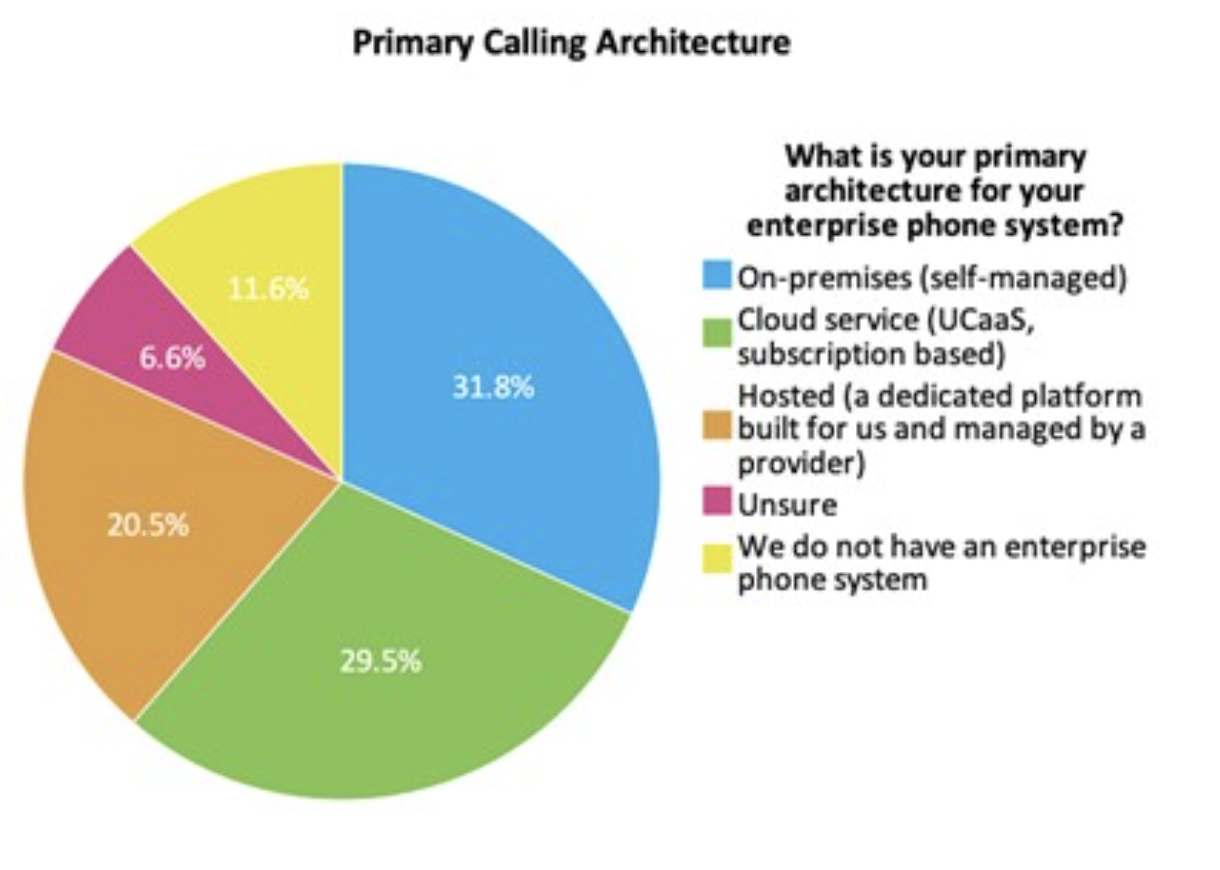
For businesses that are in the migration cycle, according to worldwide respondents in the same study, the number one reason for moving to UCaaS is cost savings, followed by supporting a remote workforce, access to enhanced features, and scalability. Conversely, key factors for businesses sticking with on-premises based PBXs include ongoing ROI for voice systems, misconceptions around cloud calling, and competing priorities. As a driving factor on both sides (cloud and on-prem), cost is an important pivot point for switching.
As businesses migrate voice and UC solutions to cloud calling, there continues to be a need to maintain legacy PBX solutions on-premises during the transition to unify their solutions over time. Managing the migration to cloud calling depends on multiple factors but the larger the company the more complicated the transaction. Depending on the size of migration, the move to UCaaS can take months if not years.
Consider a real-life example, a global manufacturing firm with over 30,000 users has multiple, on-prem PBX systems across two different vendors and Microsoft Teams for collaboration and meetings. In 2023, the company started migrating calling to Microsoft Teams through Direct Routing, with a two-year timeframe plan in place.
Continue reading at nojitter.com.
Gathering and analyzing collaboration data helps companies guide employees on best behaviors, and more.
Video meetings are business as usual these days, but not all companies are reaping full value from this mode of collaborative work. Many fail to take advantage of what video meetings can tell them about how employees behave throughout the day, and therefore are missing out on the opportunity for data-driven decision making.
Collaboration data is one of the data types that most companies have at their disposal for gaining insight into employee experience. In analyzing collaboration data, team leaders, IT, HR, and other business managers can gain an overview of how often, in what ways, and with whom employees are digitally interacting throughout the day via applications such as team chat and video meetings. Optionally, employees see their own collaboration data for an individualized view on usage and positive and negative behavioral patterns.
Of the 500 companies that participated in Metrigy’s global Employee Experience: 2023-24 research study, 53% are using collaboration data. This is the second most-used type of data, behind engagement data, which 61.3% of companies use. Engagement data gathered from enterprise social networking and elsewhere shows how much an employee participates and engages digitally with the company and peers. The two types of data, along with employee sentiment—in use by 51.7% of companies—help form a well-rounded view of employee experience.
But understanding employee behavior is just the first step. Additional value comes for companies that use the data to guide their employees toward positive improvements in factors such as productivity and wellness that affect their overall experience. Team leaders or HR executives might evaluate the collaborative behavior of the best-performing teams against the collaborative behavior of under-performing teams, for example.
Companies already using collaboration data can analyze the data from video meetings to understand meeting behavior, based on factors such as number of participants, frequency, and duration. Analyzing the data can tell them:
Continue reading at nojitter.com.
Metrigy’s Irwin Lazar and Diane Myers will be on hand at EC2024 to share insights on 911, AI for employee collaboration, premises-to-UC cloud migration, collaboration security, and more. Tune in to hear what’s on their mind for the event, and beyond.
Explore Microsoft Teams Premium and Copilot to understand their AI productivity features and select the product license best suited for your team’s needs.
Microsoft Teams has gained widespread adoption over the last several years. Nearly two-thirds of companies use Teams, according to Metrigy’s “Workplace Collaboration MetriCast: 2023” study, which surveyed more than 1,400 businesses. Teams is also the most widely adopted app for team messaging and video-enabled meetings.
Now, Teams users have the ability to take advantage of new add-on options that deliver new capabilities to improve productivity and management.
Microsoft introduced Microsoft Teams Premium in early 2023 as an add-on option for existing Teams license holders. At the same time, Microsoft also introduced Copilot for Microsoft Teams, with subsequent feature enhancements announced in July and November of the same year.
What is Microsoft Teams Premium?
Microsoft Teams Premium is an add-on license that provides several additional capabilities on top of the base Teams feature set, including the following:
- Customizable meetings for branding and templates.
- In-meeting closed captioning, with translation.
- Increased meeting host controls over content sharing.
- Meeting participation reporting.
- Support for enterprise content delivery networking to optimize bandwidth for large one-to-many meetings, like town halls.
- Enhanced features for webinars, such as reporting and attendee management.
- Larger audience support for town halls.
Microsoft Teams Premium also uses OpenAI’s GPT-3.5 large language model to provide AI-based meeting capabilities, including the following:
Continue reading at techtarget.com.


